
15 February
Dear Friends,
Writing about the Psalms, theologian-priest Emmanuel Katongole notes how a covenant relationship with God enabled biblical Israel to cry out to God: “How long, O God, will you hide your face?” Because of their intimate relationship with God through the covenant, they believed that God could, should, and would do something to save them. This is why, in the Psalms, we get some of the most honest reflections on human suffering. They could complain, mourn, weep, chant dirges, and curse, trusting that these actions are in fact a form of prayer. They did not always stand with their arms stretched out to heaven in praise and thanksgiving. Katongole says: “They praised God, but they also assailed the ears of God, protesting God’s continued silence and pressing God for deliverance”.
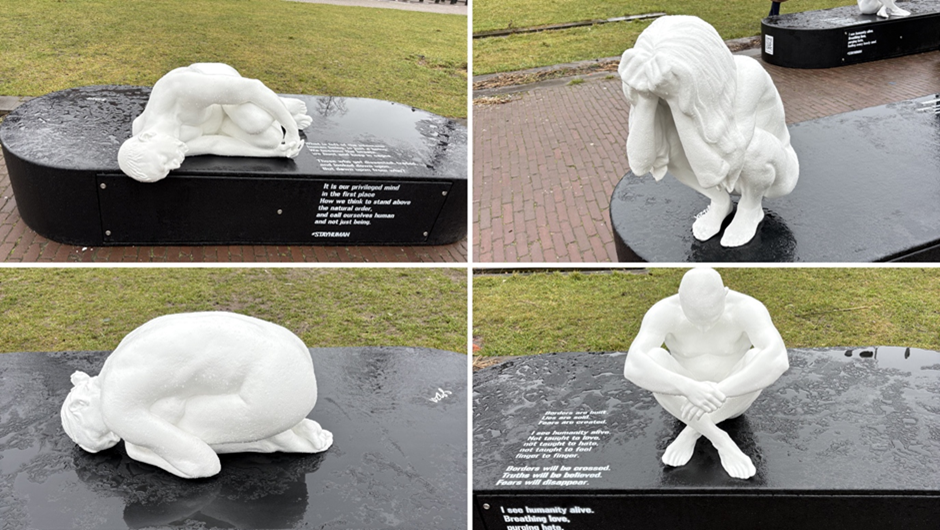
As I was walking the dogs on Museumplein this week, I was surprised to find four curled-up silhouettes of suffering victims, next to each the hashtag “stay human”. Not immediately sure what the artwork was trying to convey, I thought the artist surely understood that we are about to enter the time of Lent. Together we are curled up, sitting with our heads bowed, with our hands in our hair. What’s more, the hashtag seemed to suggest that this is, in fact, what it means to be human. This is the “from dust-to-dust” reality we need to face during Lent. Not to assail it, or cover it in cloaks of politeness or optimism, but to take our place next to those suffering people, to “pray” in curled-up form, not sure if God will answer or remain hidden.
On the mountain of “transfiguration”, our theme for this Sunday, it also seems as though God is playing hide and seek. Just shortly after experiencing a biblical theophany, an appearance of the glory of God, we see Jesus standing alone. His disciples are instructed not to share what they have seen. What’s more is that these God appearances come from the cloud, the mystery, the uncertainty. It is in the midst of cloudiness that they hear God’s voice. When he goes down from the mountain, it seems like nothing changes. Business as usual. Only, of course, “business” here refers to God’s active intervention in Jesus Christ to come alongside, even take the place of, this curled-up humanity. Perhaps that’s the paradox of God's silence, God’s hiddenness: we see in these seemingly insignificant acts of Jesus heading to the cross the glory of God shining brightly.
It turned out that the artwork was installed in view of the American embassy to protest the violent ICE raids and strict immigration rules in the US. Artist SAZZA decries the fact that a country can claim freedom, justice, and humanity while it dehumanises people. Therefore, her plea: stay human! Of course, we need not keep our heads in the cloud of American politics to understand the same suffering all around us.
And so, may we enter more deeply into the suffering around us during this season of Lent. May we trust that our complaining, mourning, weeping, chanting, and cursing reach the ears of God. As Julian of Norwich wrote: “And thus I saw him, and I sought him”, “And I had him, and I lacked him”.
Marius Louw
___