
Dear friends,
In a recent article, “The Bible Chapter That Helps Explain the New Christian Left”, the New York Times argues that our reading for Sunday, Matthew 25:31-46, could be seen as the text of the year in the United States. In their view, Matthew 25 could provide the key to understanding the rise of the religious left. They refer to the US senator Raphael Warnock, who has for years called himself a “Matthew 25 Christian”. Others like James Talarico of Texas, Adam Hamilton of Kansas and Sarah Garriott of Iowa have all used this text explicitly on their campaign trails leading up to the midterm elections. Matthew 25, they argue, provides a kind of antidote to a particular form of Christian Nationalism. It provides language for policy formation, inclusion and justice to a so-called Christian nation bogged down by an individualistic religiosity.
It is not surprising, though. The radical implications of this reading for church and state did not originate with the new religious left in the States. Jesus’s insistence that “just as you did it to one of the least of these brothers and sisters of mine, you did it to me” has been a litmus test for Christian action throughout the centuries. In fact, the church fathers were perhaps the most direct. Consider the following well-known passages:
Saint Basil the Great (330-379 AD) wrote:
“Fling wide your doors; give your wealth free passage everywhere! As a great river flows by a thousand channels through fertile country, so let your wealth run through many conduits to the homes of the poor. Wells that are drawn from flow the better; left unused, they go foul…Money kept standing idle is worthless; but moving and changing hands it benefits the community and brings increase… ‘I am wronging no one,’ you say, ‘I am merely holding on to what is mine.’ What is yours! Who gave it to you so that you could bring it into life with you?” (…) “Did you not come naked out of the womb? Will you not go naked back into the earth?”
And:
“The bread in your hoard belongs to the hungry; the cloak in your wardrobe belongs to the naked; the shoes you let rot belong to the barefoot; the money in your vaults belongs to the destitute; All these you might help and do not—to all these you are doing wrong.”
Saint John Chrysostom (347-407 AD):
“If a poor man comes to you asking for bread, there is no end of complaints and reproaches and charges of idleness; you upbraid him, insult him, jeer at him. You fail to realize that you too are idle and yet God grants you gifts. Now don’t tell me that you actually work hard. If you call earning money, making business deals, and caring for your possessions ‘work’, I say, ‘No, that is not work. But alms, prayers, the protection of the injured and the like – these are genuine work.’ You charge the poor with idleness; I charge you with corrupt behaviour. “Mine” and “thine” – these chilling words which introduce innumerable wars into the world – should be eliminated from the church. Then the poor would not envy the rich, because there would be no rich. Neither would the poor be despised by the rich, for there would be no poor. All things would be in common.”
Saint Augustine of Hippo (354-430 AD):
The superfluities of the rich are the necessities of the poor. When you possess superfluity, you possess what belongs to others. God gives the world to the poor as well as to the rich.
Redouble your charity. For, on account of the things which each one of us possesses singly, wars exist, hatreds, discords, strife among human beings, tumults, dissensions, scandals, sins, injustices, and murders. Why? Do we fight over the things we possess in common? We inhale this air in common with others, we all see the sun in common.
Blessed therefore are those who make room for the Lord, so as not to take pleasure in private property. Let us therefore abstain from the possessions of private property – or from the love of it, if we cannot abstain from possession – and let us make room for the Lord.
There are many more examples we could quote from our rich church tradition. The question, though, is not a lack of knowledge of the importance of what Jesus is saying; it is the difficulty of putting our belief into action. I do not wish to oversimplify the matter either. These are nuanced and confronting conversations. Nevertheless, this is what the gospel puts in front of us right at the end of the church year: blessing, salvation and citizenship in the kingdom of God are not measured by the right beliefs, doctrines or creeds. It comes down to our treatment of the least of these. That is what matters to the great king of the cosmos.
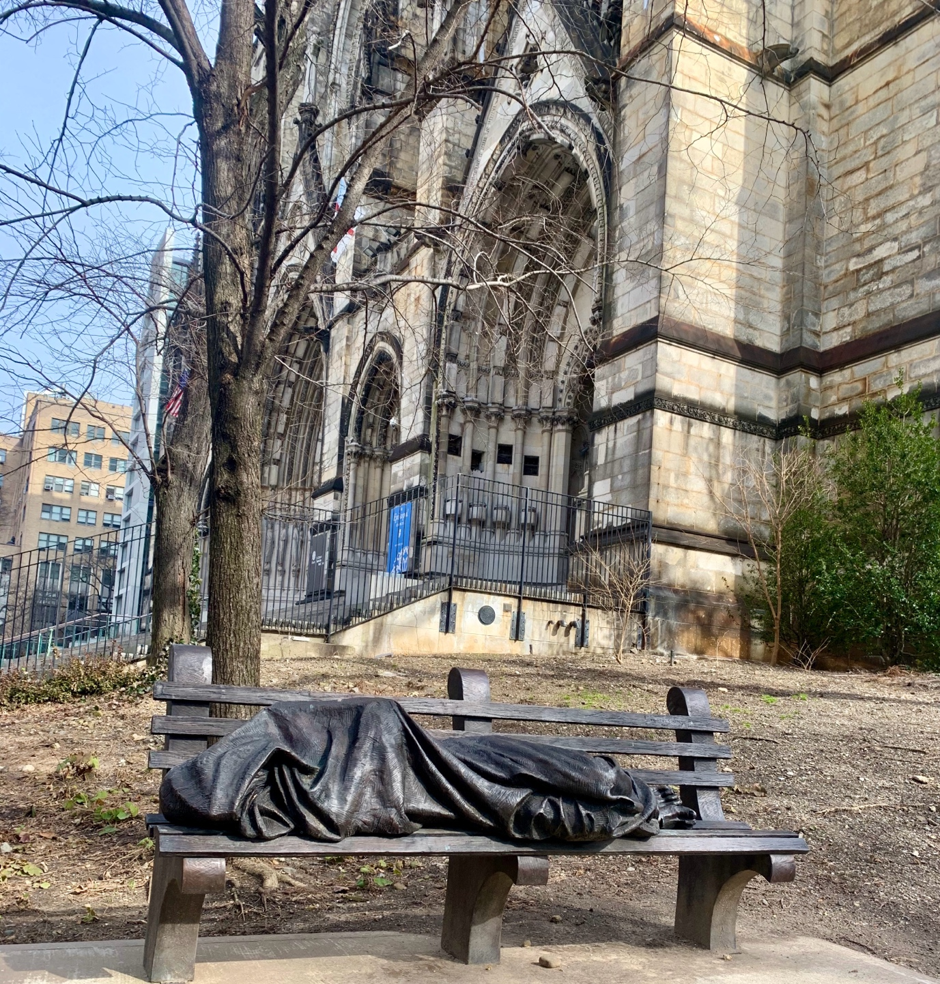
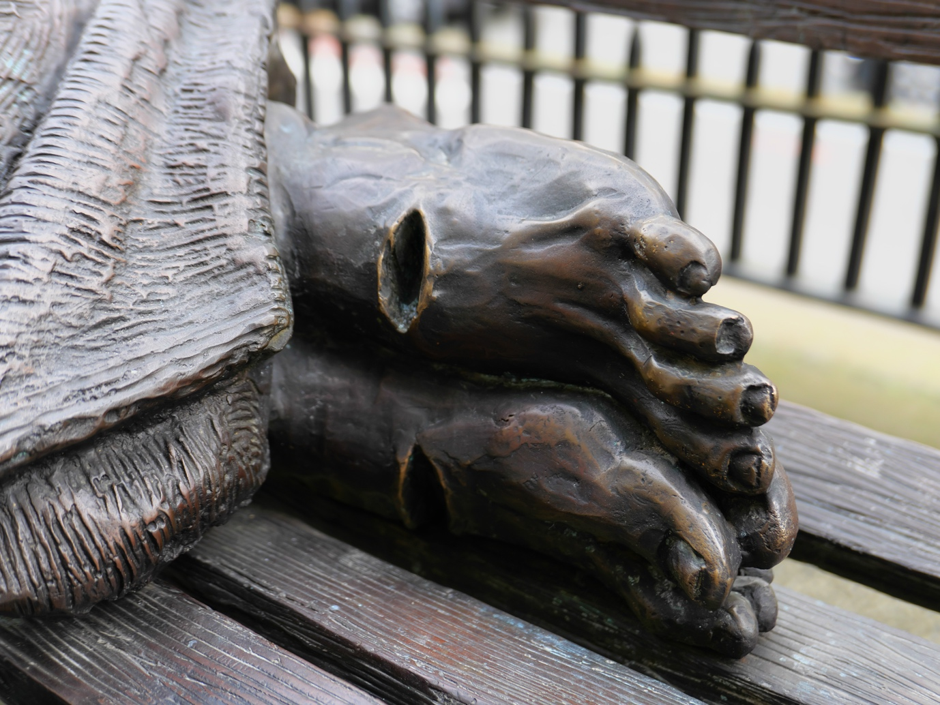
I am including the beautiful and influential sculpture of Timothy Schmalz, “Homeless Jesus”, as a subject for further meditation in the run-up to Sunday’s service.
Blessed weekend
Marius