25 April
Dear Friends
How do Christians relate to the broader culture around us? How are we to act, think, speak, shop, rest and so forth as Christian people situated in a predominantly non-religious environment? In our news and politics, not least in the shockingly disconcerting image of Donald Trump portraying himself as Jesus Christ, it often seems as though those in power want to get Christ on their side. Christ becomes a by-product of culture.
Several people have tried to answer this question, often by appealing to the Bible. In his Christ and Culture , for example, Richard Niebuhr famously sought to show how this relationship changes throughout the writings of the early church. In 1 John we see “Christ against culture”. In the Gnostic writings it is about the “Christ of culture”. For Matthew it is about “Christ above culture”, and in Paul’s writings it is about “Christ as the transformer of culture”. The First Letter of Peter, which we are exploring in church at the moment, stands out as a New Testament text that absolutely highlights this tension between Christ and culture. It is about a small community, consisting of marginal figures – most notably slaves and women – trying to honour their relationship to Christ in surroundings that want to thwart that relationship at every opportunity.
So how are we to live as Christians in our culture, time and world? How do we relate to the things happening around us? I will try to answer that question on Sunday, but for now, let me leave you with a clue. 1 Peter often refers to its addressees as “strangers”, “sojourners” and “aliens”. They are the odd ones out, the weirdos. It is exactly their strangeness, linked to the strangeness of Christ, that makes their presence so unbearable to the norms and values of their oppressive surroundings. They stand out like a sore thumb. That is not to say, though, that they see themselves as “holier than thou”. Quite the contrary. They are the light-bringers in a world that has succumbed to the mundane and boring routines of exclusion, power and hatred. To a society focused on darkness, the light-bringers can surely look like weirdos.
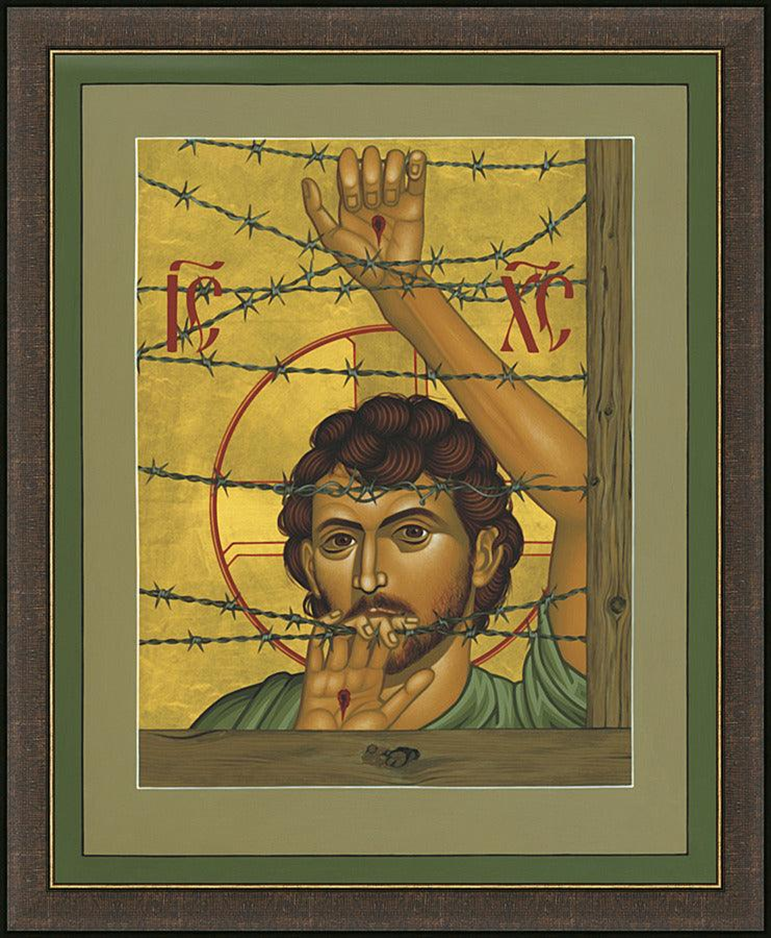
This reminded me of an image I saw again this week – Br. Robert Lentz’s Christ of Maryknoll. In the icon, Lentz intended to show that Christ is always “on the other side”. He is always on the “other side” of barbed wire, prison bars, walls, borders, ethnicity, citizenship, political party, or religion. What is deliberately unclear, however, is whether Christ is the one caught in the prison camp, behind the wire (thus as the refugee, stranger, sojourner, prisoner, alien), or whether Christ is actually the one on the outside – freed – looking in to see us (thus indicating that we are the strangers, aliens, whom Christ is ready to save). Both seem equally true.
Marius Louw