
6 March
Dear Friends,
This week, we are meeting in Geneva for our International Presbytery gathering. It is wonderful to see all the familiar faces of our friends from our “neighbouring” churches. As it is my first time in Geneva, I have committed myself to a reformed pilgrimage. Like all pilgrims’ experiences, it has been a true joy to witness the voices of Calvin and Knox coming alive. As is often said, perhaps jokingly, Geneva is to the Reformed what Rome is to Catholics.
Many people these days neither know nor care about who John Calvin was. For those who do, he has come to represent rigid doctrines and Swiss repressive theocracy, not to mention the horrifying consequences in the Netherlands and apartheid South Africa.
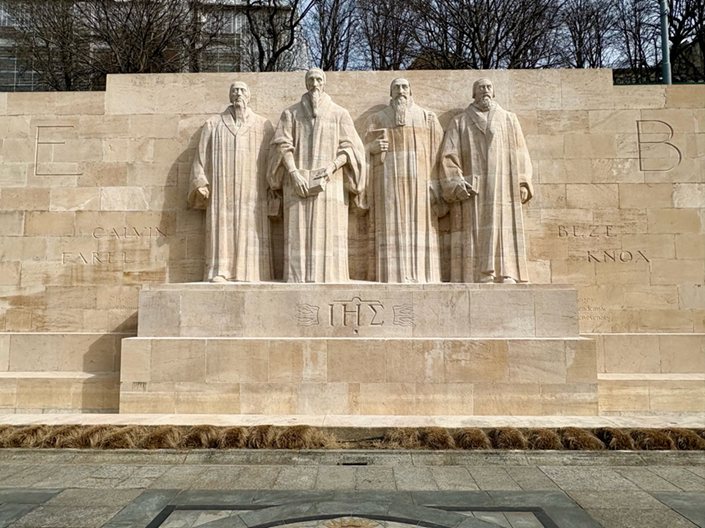
In the theological faculty at Stellenbosch, where I studied, we never encountered this version of Calvin. We belonged to a new generation, reading Calvin very critically. For us, Calvin was always an indispensable source for challenging oppressive and unjust systems, and someone who sought to comfort the afflicted in his community. A refugee, as it were. I realise that this is not the whole truth. It is certainly a way of “reading the tradition against the tradition”, as many theologians in the global South would assert. It is a way of interpreting these thoughts and doctrines not for their oppressive and constraining ends, but for their liberating potential. One figure who demonstrated this approach was Alan Boesak, the anti-apartheid activist.
Nevertheless, here I was, sitting beneath a massive statue of Calvin, coincidentally reading a book by the reformed theologian Serene Jones, Trauma and Grace: Theology in a Ruptured World, in preparation for Easter. Jones shares an insight from Calvin’s life that I found very interesting. In his writings, she says, we meet a person who was deeply concerned with the world and the people around him. In the introduction to his Commentary on the Psalms, for example, we see a rare autobiographical glimpse into his life at that time. As Jones observes,
“The story he tells is bracingly intense, a better read than many a modern-day adventure tale. He describes how, as a young and restless scholar in Paris in the mid-1500s, he suddenly found himself on the wrong end of a brewing civil war inside the royal family, and how, in the middle of the night and under the cloud of darkness, he secretly fled his French homeland, just barely escaping imprisonment and execution.”
In a small German town, he then, almost by accident, ended up ministering to similarly outcast French folk. Again, Jones puts it well:
“As Calvin narrates it, this flock of so-called outlaws had been brutalised, as had their family members who remained behind in France. The list of atrocities they suffered was long: they were ‘maimed, executed, tortured, burned, and assailed on all sides by the wicked’.”
It is precisely in these circumstances that people turned to him for wisdom and pastoral care. This qualifies him as a theologian who truly understood the relationship between violence and grace, or “trauma and grace”, as Jones notes.
I do not wish to offer a defence of Calvin’s life or reception, certainly not!
I do wonder, though, what liberating message we should hold onto during these confusingly violent and, for many in our world, traumatic times. What are the words of wisdom and care we need to speak for a moment such as ours?
Marius Louw