30 May
Dear Friends
As I prepare for our Consistory Away Day tomorrow, I am once again struck by the fourth mission statement of our congregation: to transform the unjust structures of society.
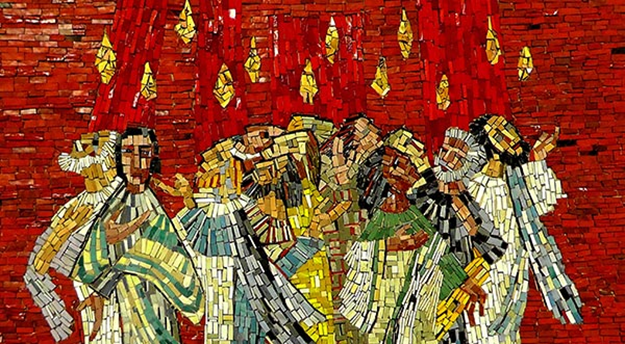
Last Sunday we spoke about how the Holy Spirit is not simply some ominous, ghost-like figure that descends upon the church in a mysterious and unknown form. Instead, what is surprising about Pentecost is the profound knowability and understanding created by the Spirit in that moment. People could hear, each in their own language. This Spirit certainly moves like the wind; it cannot be controlled or domesticated. Yet that is not the same as saying that this Spirit is simply unknowable. We can know what it looks like when the Spirit animates human beings. Throughout the Bible, we come to know this Spirit as one that comes to “rest” on certain individuals, especially in situations that are profoundly unjust and unloving. Isaiah 11, 42, and 61 are all good examples of this.
In each case, when the Spirit rests on this person, they become an agent of God’s transformative work here on earth. More profoundly, they become an agent of justice. Isaiah 11, for example, tells us what happens when the Spirit descends on the messianic shoot from the stump of Jesse: “He shall not judge by what his eyes see or decide by what his ears hear, but with righteousness he shall judge for the poor and decide with equity for the oppressed of the earth; he shall strike the earth with the rod of his mouth, and with the breath of his lips he shall kill the wicked. Righteousness shall be the belt around his waist, and faithfulness the belt around his loins.”
Not only did the Spirit descend on people in this way in the Old Testament, but Jesus also very deliberately reads from exactly this scroll in the synagogue in Luke 4. It is this same Spirit that animated Jesus Christ in his life, death, and resurrection. To say that the church is a Pentecost community, then, is also to say that we are a community animated by the Spirit of justice. What might that mean for how we think about ourselves and our work in our communities?
On Sunday we will explore exactly this point as we look at “The Spirit of Justice.” This will be part of a short series on the attributes and work of the Holy Spirit. In this series we will also consider “the Spirit of creation,” “the Spirit of creativity,” and “the Spirit of imagination.” I warmly invite you to follow along!
Marius Louw